
As an online platform, Airbnb changes people’s traveling and vacationing in a revolutionary way. It is a completely online agency platform. Plus, it can even be said that Airbnb are companies that would have no business without the technologies of the Internet. The two fundamental business models that utilized by Airbnb were two-sided market model and sharing economy, which could be considered as the possible reason why it is more successful than other online rental platforms. On the one hand, it is community-based and closely links the host and the traveler, simplifying the rental process, while the platform itself is not owning any rooms (Moore, 2019). Besides, it fosters the sharing-economy by allowing owners to rent private apartments. Moreover, studies have shown that the average Airbnb rate is $ 22 cheaper than a hotel, but prices vary widely depending on the type of accommodation you are looking for and the city you will stay (Moore, 2019). Because of this, Airbnb’s target customers tend to be travelers who are looking for accommodation that is functional and comfortable, at the same time, on the premise of limited budget. There is a short video below from fundersandfounders (2014) introduces Airbnb’s story and origins:
So far, Airbnb has become one of the most valuable companies in the world (Statista, 2020). In 2020, Airbnb has more than 150 million users and 6 million listings all over the world. Besides, it offers listings in 65,000 cities among over 191 countries. Its achievements are inseparable from its unique digital business model.
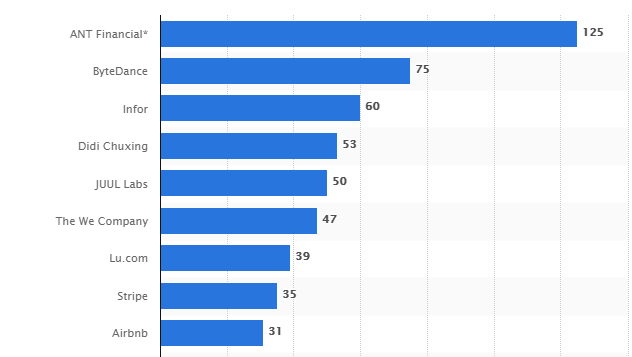
Figure from Statista (2020) https://www.statista.com/statistics/407888/ranking-of-highest-valued-startup-companies-worldwide/
Airbnb is a successful online two-side platform—which is a business model for economic exchange between two different user groups that could benefit each other from large networks. By providing host protection insurance and a reputation and review system, the platform builds trust in the user community and reduces transaction costs. Profiles and user reviews help build reputation and trust among market participants. For each booking, Airbnb charges commissions from two sources, the commission from the host and the guest. Airbnb charges guests 6-12% of the booking fee for each booking. In addition, Airbnb charges the landlord a 3% fee for each successful transaction (Business Model Toolbox, 2015).
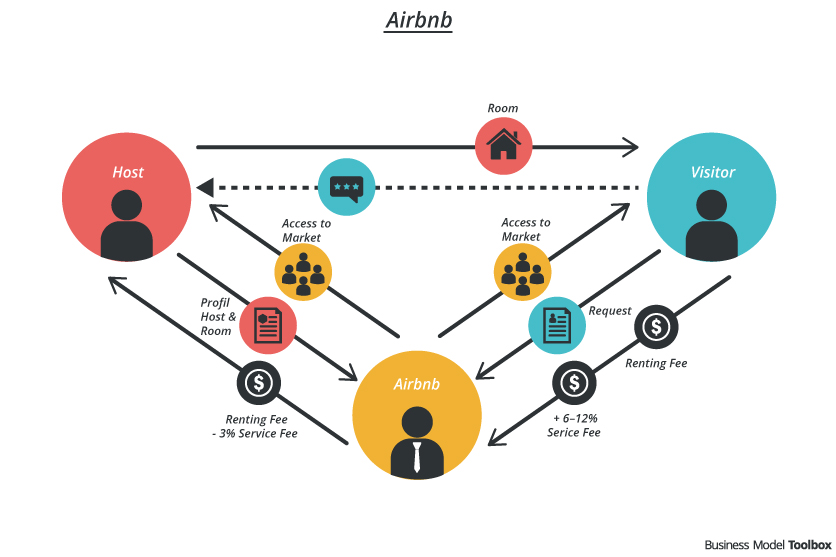
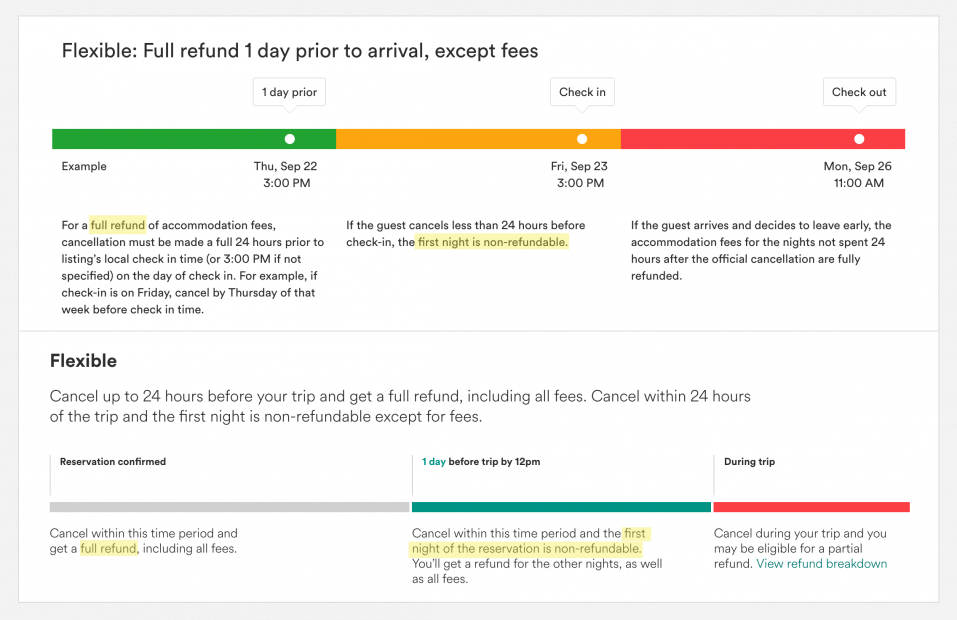
Airbnb’s two-side market advantage could be reflected in several aspects. Firstly, it saves the time and money for both parties to find broker services in the marketplace. For landlords, Airbnb does not require additional conditions, just complete registration through the Internet to become an accommodation on Airbnb’s listing. On the other hand, guests could directly and simply enter criteria on the webpage or Airbnb’s App to filter the listings that meet their expectations. Secondly, the involvement of the platform reduces the hassle and friction in finding services. Airbnb guarantees the security of the reservation and free cancellation. Furthermore, guests can refund the Airbnb service fee in full within 48 hours of booking. When the accommodation fee is refunded, and cleaning fee will also be refunded (iGMS, 2018). For the householder, if the guest causes damage to the room facilities during the residence process, there is a corresponding policy to protect their legal rights.
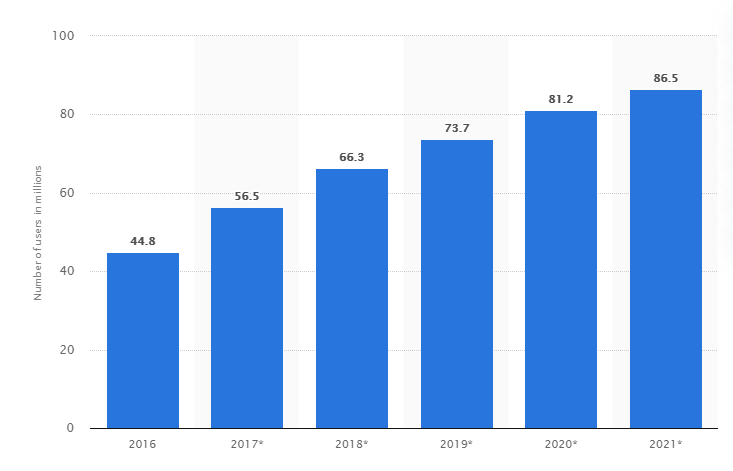
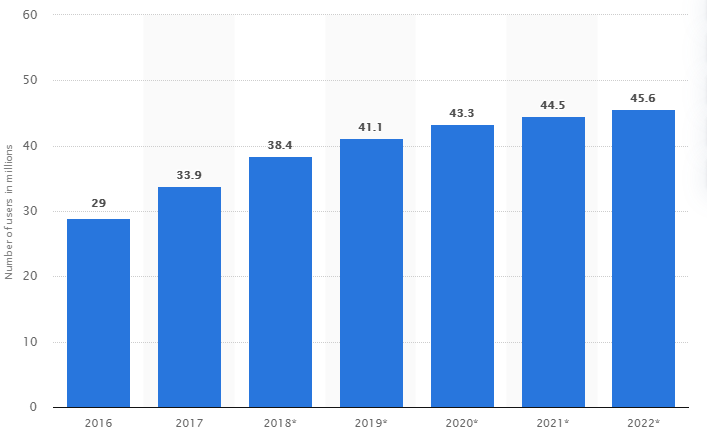
In addition to this, Airbnb has seized the opportunity of the sharing economy market, which could be recognized as another decisive factor for its success. Taking the United States as an example, a reasonable guess from the analysis of the data by eMarketer (2017) shows that sharing service users in the United States are expected to reach 86.5 million in 2021. This undoubtedly proves that the sharing economy is a market with great potential. At the same time, eMarketer (2018) also speculated that the total number of Airbnb users may reach 45.6million in 2022.
One of the advantages of the sharing economy is that it allows the use and sharing of resources without owning them. This allows Airbnb to conduct accommodation transactions without the requirement to own any listings, reducing the cost of organization operations. In addition, the sharing economy followed by Airbnb could make direct and extra profits for local hosts. If hosts have extra rooms, they could join Airbnb’s listings to get extra revenues. This makes people feel more enthusiastic about joining Airbnb.

In a brief conclusion, Airbnb’s success is closely related to its unique business model and grasping market opportunities. As a network platform that relies entirely on digital technology, households and guests can have a direct dialogue through internet, and Airbnb only serves as a medium. Airbnb’s two-way market model can provide users with free entry while collecting commissions from both parties. At the same time, the number of active users on the platform can also be directly converted into the platform’s revenue-through advertising, etc. Besides, the sharing economy that Airbnb follows is an emerging economic model. With continuous improvement, travellers tend to use sharing services to reduce demand while reducing costs. Although it will not be completely replaced, Airbnb has already had a huge impact on the hospitality industry due to convenience, personalization and affordability. According to people’s positive attitude towards sharing service, Airbnb’s development prospects are undoubtedly bright.

References
Airbnb Statistics (2020). User & Market Growth Data. Retrieved 3 March 2020, from https://ipropertymanagement.com/research/airbnb-statistics
Business Model Toolbox. (2015). Airbnb Business Model Retrieved 3 March 2020, from https://bmtoolbox.net/stories/airbnb/
eMarketer (2018). Airbnb: number of users U.S. 2016-2022 | Statista.. Retrieved 4 March 2020, from https://www.statista.com/statistics/346589/number-of-us-airbnb-users/
eMarketer (2017). Sharing economy statistics | Statista.. Retrieved 4 March 2020, from https://www.statista.com/statistics/289856/number-sharing-economy-users-us/
iGMS. (2020). How Does the Airbnb Cancellation Policy Work? Retrieved 3 March 2020, from https://www.igms.com/airbnb-cancellation-policy/
Moore, S. (2019). What is Airbnb and how does it work?. Retrieved 2 March 2020, from https://dgit.com/what-is-airbnb-55084/
Statista. (2020). Highest valued unicorn companies globally 2020. Retrieved 2 March 2020, from https://www.statista.com/statistics/407888/ranking-of-highest-valued-startup-companies-worldwide/
 Digital Business Models
Hi, Yaxin. I really like your analysis of Airbnb ‘s business model. Thank you for sharing the knowledge of the two-way market model and the emerging economic model. Frankly speaking, before that I know how Airbnb makes money, but I did not consider it from the perspective of the business digital model. I agree with you that the majority of successes for Airbnb attributes to grasping sharing economy; however, some issues may be ignored with the growth of sharing economy. Firstly, the problem of safety. Although the registration system of Airbnb has verification, the registration process is too easy. Well, Uber is confronted with the same problem. Secondly, some Airbnb listing is not based on sharing economy, as the core of sharing economy is the utilisation of redundant assets; however, Airbnb also allows some hosts to operate and manage permanent rentals (Gyódi, 2019). How do you think about?
Gyódi, K. (2019). Airbnb in European cities: Business as usual or true sharing economy?. Journal of cleaner production, 221, 536-551. doi: 10.1016/j.jclepro.2019.02.221.
LikeLike